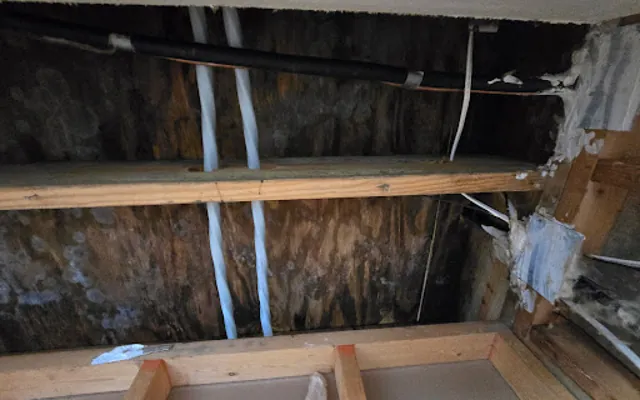
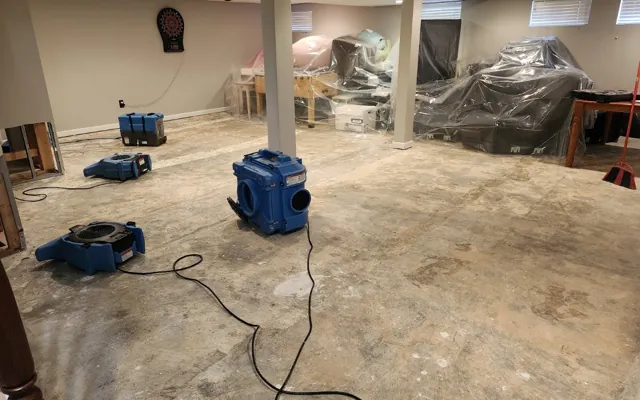
Nassau Bay's established homes near Clear Lake sit in a waterfront microclimate where rare ice storms can create surprising roof damage if freezing rain backs water under shingles. The IICRC-standard crew reaches you immediately to extract the leak, remove saturated insulation and drywall, and verify attic drying for safe rebuild.

Crews trace the water intrusion point at the roof edge, soffit, or gutter line and determine how far water has penetrated into the Nassau Bay attic and ceiling cavities.
Truck-mounted extraction equipment removes standing water and pooled ice melt from attic and ceiling spaces throughout the affected Nassau Bay home.
Saturated insulation and damaged drywall are removed, air movers and dehumidifiers operate continuously, and daily moisture readings confirm trained-dry status before rebuild begins.

Ice-related roof leak cleanup in Nassau Bay typically runs $600 to $4,000, depending on how much ceiling drywall and insulation were affected and whether gutter or shingle repair is also needed. Because this is a rare event tied to specific freezing rain or ice storm conditions, most claims involve a single ceiling section rather than widespread damage. Coverage generally applies as a storm-related loss under a standard homeowner's policy.
Nassau Bay's established neighborhoods near the Johnson Space Center feature homes built in various eras, many with roofs designed for rain drainage under normal conditions but vulnerable to ice-dam formation during the rare freezing-rain event. When sleet or freezing rain combines with wind, water can be forced backward under shingles, penetrating the attic before temperatures rise and ice melts. Nassau Bay's waterfront position creates a microclimate where freezing rain is possible, though uncommon. The proximity to Clear Lake can cool air temperatures slightly longer than inland areas, increasing ice-dam vulnerability during rare freeze events. Older established homes in Nassau Bay have roof designs dating to eras when ice-dam protection was not standard, making them more susceptible. From Nassau Bay, crews also cover nearby Arcola, Webster, Alvin, Pasadena, Fresno, Manvel. See every neighborhood and town on the full service area page.
See all areas servedEvery loss is photographed, measured, and logged from the first visit, so the paperwork holds up with your insurance carrier.
Technicians follow recognized IICRC drying standards and prove the work with daily moisture readings, not guesswork.
Emergency dispatch any hour of the day or night, with a real crew on the way, not a callback in the morning.
A real crew dispatched any hour, not a callback in the morning.
Trained technicians following recognized IICRC drying standards.
Truck-mounted, portable, and submersible for any size loss.
The loss is documented and billed to the carrier directly.
Ice-dam damage caused by freezing rain and ice accumulation is typically covered as a storm-related loss under standard homeowner policies. Check your specific policy, as coverage depends on how the damage is categorized. Crews provide detailed documentation for your claim.
In Nassau Bay's warm, humid climate, mold can begin growing on wet insulation within twenty-four to forty-eight hours. Fast extraction and drying are critical to prevent health hazards and structural damage. The crew prioritizes immediate response and around-the-clock dehumidification.
Crews are on call 24 hours a day and can be on the way to Nassau Bay within the hour.
Call (832) 979-6332