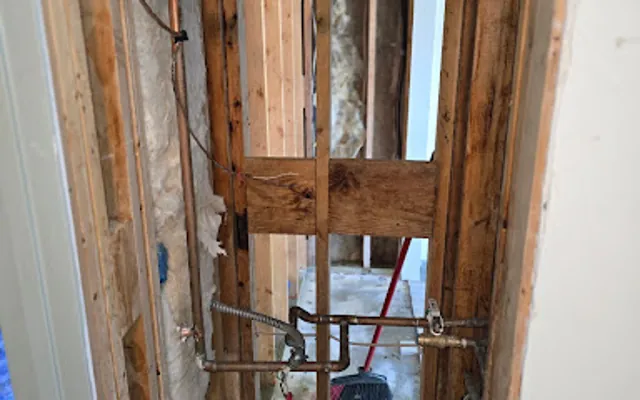
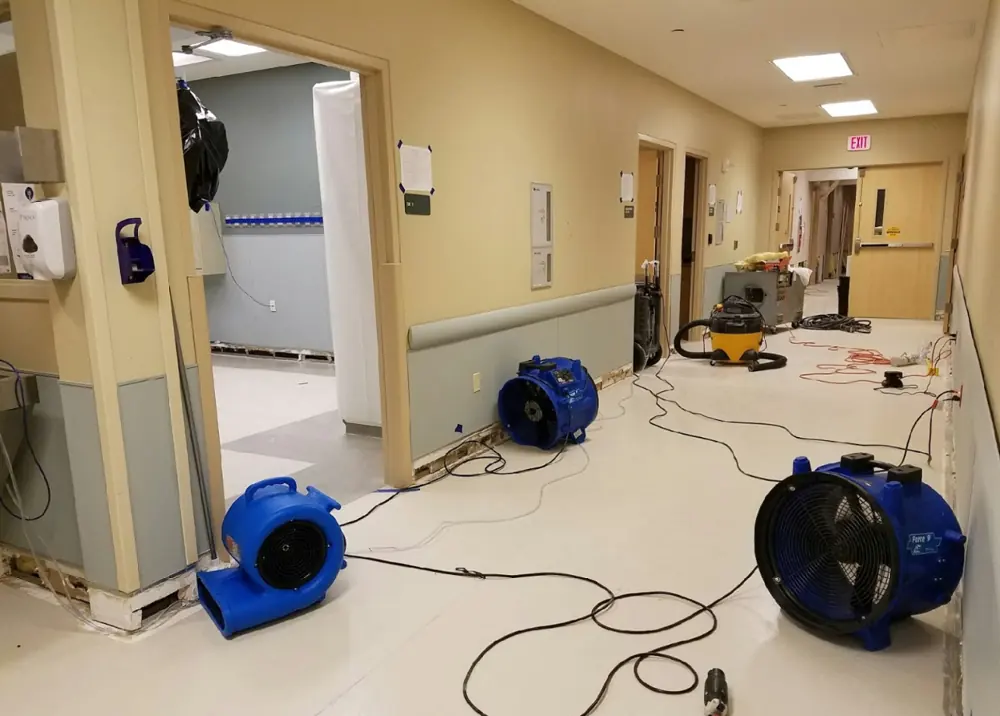
When an exposed pipe gives way during a rare Gulf Coast cold snap, water often travels along the slab under cabinets and through wall cavities before it reaches a visible floor. The IICRC-standard crews reach most Pearland homes in about an hour to trace it.

Crews trace the burst section, whether it is in the attic, garage, or an exterior wall, and shut off water at the main to stop further loss right away.
Standing water is extracted from flooring, cabinet bases, and any adjoining rooms the water reached while traveling along the slab surface during the cold snap.
Air movers and commercial dehumidifiers dry wall cavities, subfloor, and slab-level materials, with daily moisture checks tracking progress carefully until every reading comes back safe.
Crews coordinate pipe repair with a professional plumber and rebuild affected drywall, flooring, and cabinetry once every area tests fully dry throughout the entire home.

While help is on the way, these first steps, done only where it is safe, limit the damage and protect the insurance claim.
Shut the supply off at the source, or close the home's main valve if the source is not obvious. Stopping the flow limits the damage more than anything else.
Switch off electricity to the affected area, but only if the breaker can be reached without standing in or touching the water.
Get a crew dispatched right away. The sooner extraction and drying begin, the more flooring, drywall, and belongings can be saved.
Take photos and a short video of the water and the affected rooms before anything is moved, so the insurance claim starts strong.
Frozen pipe water damage in Pearland typically runs $1,500 to $9,000, depending on where the pipe burst, how far water traveled across the slab, and how many rooms were affected. A garage or attic line that drains into one room costs far less to repair than a burst that reaches multiple rooms overnight. Most homeowner's policies cover sudden pipe failure; crews document the water's path for your adjuster.
Crews reach Pearland and Greater Houston fast, from the historic Old Townsite and Brookside Village to Friendswood, Manvel, and nearby Pasadena and Alvin. See the full list on the areas served across Pearland page.
See all areas servedEvery loss is photographed, measured, and logged from the first visit, so the paperwork holds up with your insurance carrier.
Technicians follow recognized IICRC drying standards and prove the work with daily moisture readings, not guesswork.
Emergency dispatch any hour of the day or night, with a real crew on the way, not a callback in the morning.
A real crew dispatched any hour, not a callback in the morning.
Trained technicians following recognized IICRC drying standards.
Truck-mounted, portable, and submersible for any size loss.
The loss is documented and billed to the carrier directly.
It happens, but rarely. Most winters bring nothing colder than a light chill, but the area does see occasional freezing temperatures, and severe outlier events like February 2021 have caused widespread pipe failures across the region. Exposed lines in garages, attics, and exterior walls are the ones at real risk.
Exterior hose bibs, garage supply lines, attic runs, and any pipe routed along an uninsulated exterior wall are the most exposed sections in a typical home. Pipes inside conditioned living space rarely have a problem even during a cold snap.
Because nearly every home here sits on a slab, water from a burst pipe travels along the surface of the slab and through wall cavities rather than pooling in a basement below. It can reach adjoining rooms before anyone ever notices.
Most policies cover sudden pipe bursts from freezing, since it is considered an accidental and unexpected event rather than gradual wear. Crews document the extent of the water's path so your adjuster can see the full scope of the loss.
Insulate exposed lines in the garage and attic, disconnect and drain outdoor hoses, and let faucets drip slightly on nights when freezing temperatures are forecast for the area. These simple steps prevent most of the frozen pipe calls crews receive.
Pearland crews are on call 24 hours a day, local and fast, and can be on the way within the hour.
Call (832) 979-6332